

Janai Purnima is one of Nepal’s major Hindu festivals, celebrated on the full moon day of Shrawan, usually in July or August. The festival is closely associated with the renewal of the Janai, a sacred thread traditionally worn by initiated Hindu men, as well as the tying of a protective thread known as doro. These rituals represent religious renewal, purification, protection, and the continuation of spiritual obligations.
The festival, however, is broader than the changing of a sacred thread. On Janai Purnima, people visit temples, perform prayers and purification rituals, receive blessings from priests, gather with family, and prepare traditional foods such as Kwati, a nutritious soup made from a mixture of sprouted beans and legumes. For many devotees, the day is also an opportunity to strengthen their connection with religious traditions and community.
Janai Purnima is particularly significant because its customs vary across Nepal. Brahmin and Chhetri communities traditionally place greater emphasis on changing the Janai, while many other Hindu communities participate through protective-thread ceremonies, temple worship, family rituals, and local customs.
The Newar community has its own cultural interpretations and food traditions, while the annual pilgrimage to Gosaikunda is one of the country’s most prominent Janai Purnima observances. This regional and community-level diversity makes the festival an important window into Nepal’s living religious and cultural heritage.
What Is Janai Purnima?
Janai Purnima is a Hindu festival observed in Nepal on the full moon day of Shrawan, the fourth month of the traditional Nepali lunar calendar. The name itself combines Janai, referring to the sacred thread traditionally worn by initiated Hindu men, and Purnima, the Sanskrit-derived term for a full-moon day. Thus, Janai Purnima can broadly be understood as the full-moon festival associated with the sacred thread.
The sacred thread gives the festival its distinctive religious character. On this day, traditionally initiated Hindu men perform purification rituals and replace their old Janai with a new one, usually with the assistance of a priest. The act is understood as a renewal of religious commitment and ritual purity rather than simply changing a piece of clothing.
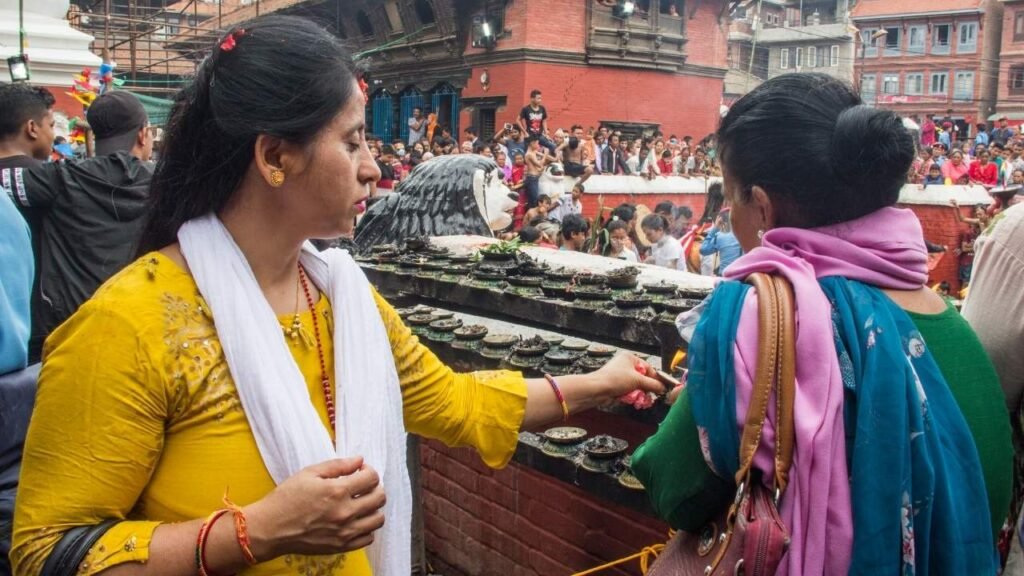
Janai Purnima also has a broader theme of protection and blessing: priests tie a consecrated thread, commonly called doro or rakshya sutra, around the wrist of devotees as a protective and auspicious symbol.
Janai Purnima and Religious Renewal
Three ideas run through many Janai Purnima practices: renewal, purification, and protection. Changing the Janai represents ritual renewal for those who traditionally wear it, while bathing and other purification practices prepare devotees for religious observance. The sacred protective thread, meanwhile, symbolizes blessings and protection.
The festival is also not celebrated identically throughout Nepal. Different Hindu communities, ethnic groups, families, and regions observe different combinations of rituals. Some emphasize the sacred-thread ceremony, while others focus more on receiving the protective thread, visiting temples, making offerings, gathering with family, or undertaking pilgrimage. Gosaikunda, in particular, becomes an important pilgrimage destination during Janai Purnima.
Quick Facts About Janai Purnima
| Detail | Information |
| Festival | Janai Purnima |
| Type | Hindu religious and cultural festival |
| Calendar | Traditional lunar calendar |
| Date | Full moon (Purnima) of Shrawan |
| Main Ritual | Renewal of the sacred Janai among those who traditionally wear it |
| Other Important Ritual | Receiving a priest-blessed protective thread (doro) |
| Important Symbol | Janai / sacred thread |
| Celebrated By | Hindu communities throughout Nepal, with regional and community variations |
| Notable Pilgrimage | Gosaikunda and other sacred sites |
One important accuracy point: Janai Purnima should not be defined solely as the “festival of changing the Janai.” That is one of its central rituals, but the festival also encompasses protective-thread ceremonies, purification, temple worship, pilgrimage, food traditions, and community-specific practices. That broader definition better reflects how Janai Purnima is actually observed across Nepal.
When Is Janai Purnima Celebrated?
Janai Purnima falls on the full moon day of Shrawan, according to the traditional Hindu lunar calendar used to determine many Nepali festivals. Because the lunar calendar does not align exactly with the Gregorian calendar, the festival does not have a fixed date in July or August each year.
In the Gregorian calendar, Janai Purnima generally occurs in July or August. The exact date depends on when the full-moon (Purnima) tithi of the month of Shrawan occurs. This is why the festival can shift by several weeks from one year to another rather than always falling on the same calendar date.
For example, Janai Purnima was observed on August 9, 2025, while in 2026 it falls on August 28. The Government of Nepal’s Embassy holiday calendar also lists August 28, 2026 (12 Bhadra 2083) as Rakshya Bandhan.
Janai Purnima Dates: 2026 to 2028
| Year | Gregorian Date | Day | Nepali Date |
| 2026 | August 28, 2026 | Friday | Bhadra 12, 2083 |
| 2027 | August 17, 2027 | Tuesday | Bhadra 1, 2084 |
| 2028 | August 5, 2028 | Saturday | Shrawan 21, 2085 |
The dates above illustrate why it is better to describe Janai Purnima as a lunar-calendar festival rather than simply saying that it is celebrated on a particular date in August.
Why Does the Date Change Every Year?
The traditional calculation is based on the lunar tithi, rather than the fixed 365-day Gregorian calendar. Purnima refers to the full-moon phase, and Janai Purnima is observed when that full-moon day corresponds to Shrawan Purnima in the traditional calendar.
This also explains why references to Janai Purnima can sometimes show slightly different dates when comparing calendars from different countries or traditions. For a Nepal-focused article, the official Nepali festival calendar and Nepal’s traditional calendar system should be treated as the primary reference.
The timing is particularly important for pilgrims. At Gosaikunda, for example, the Janai Purnima pilgrimage is specifically tied to the festival date, with devotees traveling to the sacred lake for religious observances. Nepal Tourism Board identifies Gosaikunda as one of the important places associated with Janai Purnima celebrations.
For the article, I recommend updating the date table annually rather than publishing a long list of future dates. That keeps the page useful for travelers while avoiding outdated information as the lunar calendar moves from year to year.
What Is the Religious Significance of Janai Purnima?
The religious significance of Janai Purnima is centered on the ideas of purification, renewal, protection, and religious responsibility. The festival falls on Shrawan Purnima, the full moon of Shrawan, a day considered particularly important for sacred-thread rituals in several Hindu traditions.
For those who traditionally wear the Janai, replacing the old thread with a new one is not simply a yearly custom; it is a ritual reaffirmation of religious discipline and obligations. The broader Raksha or protective-thread ceremony adds another dimension, with devotees receiving a consecrated thread and blessings for protection and well-being.
The sacred thread functions as a religious symbol rather than an ordinary piece of clothing. Its association begins with the Upanayana, a Hindu rite of passage through which an initiate enters a more disciplined stage of religious and educational life. In this context, wearing the thread carries an expectation of observing particular religious practices and duties. Janai Purnima provides an annual occasion for renewing that commitment through ritual purification and the replacement of the thread.
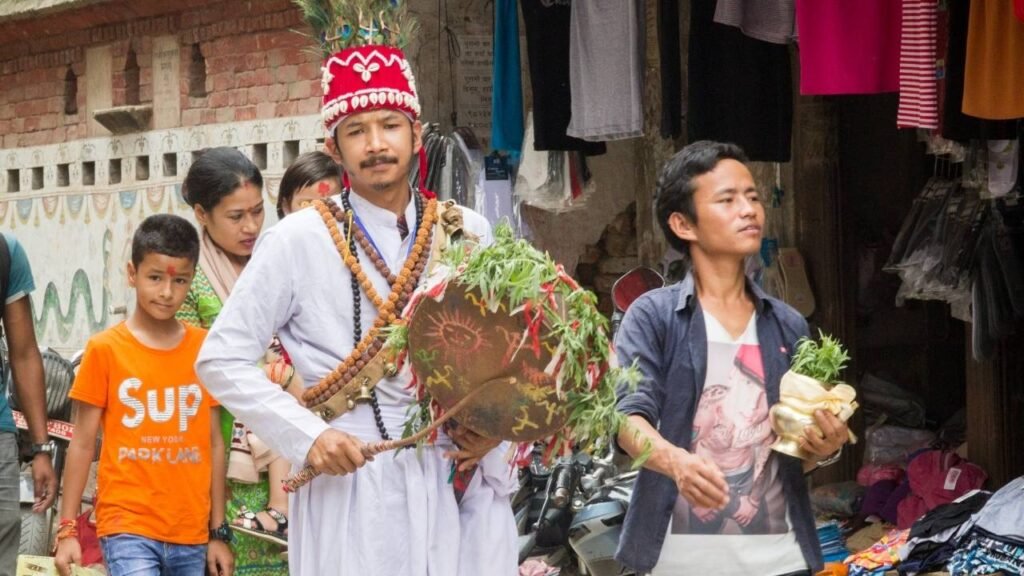
Protection is another important theme. The thread tied around the wrist during Janai Purnima is traditionally understood as a raksha sutra, or protective thread, blessed through religious ritual. Devotees may regard it as a spiritual safeguard against misfortune or negative influences, while also seeing it as a reminder of divine protection and religious faith. It is important to describe this as a religious belief and symbolic function, rather than as a claim of scientifically demonstrable protection.
The festival therefore brings together two related but distinct practices: renewing the Janai for those who traditionally wear it and receiving a protective thread for devotees more broadly. This is one reason Janai Purnima cannot be reduced simply to a “sacred-thread-changing festival.” Its meaning extends to personal purification, spiritual discipline, blessings, and community participation.
Why Is the Full Moon of Shrawan Important?
The full moon, or Purnima, has an established place in Hindu ritual calendars, and Shrawan Purnima is particularly significant for several sacred-thread observances. In Vedic traditions, the day is associated with Upakarma, a ritual renewal connected with Vedic study and the sacred thread. In Nepal, these traditions form part of the religious background of Janai Purnima, although practices differ among communities and religious lineages.
There is no single mythology that can be treated as the definitive origin of every Janai Purnima practice. The festival incorporates traditions that developed around sacred-thread renewal, protection rituals, Vedic observances, and regional Hindu customs. This layered history is important because it explains why the same full-moon day can carry several related religious meanings.
The Stories and Legends Behind Janai Purnima
Janai Purnima does not have one universally accepted origin story. Instead, the festival brings together different layers of Hindu ritual tradition and mythology, particularly traditions concerning sacred threads, protection, Vedic observance, and the full moon of Shrawan.
One of the most frequently cited stories behind the protective-thread tradition concerns Indra and Indrani (Shachi). In a narrative associated with the Bhavishya Purana, Indra was facing defeat in a battle against the Asuras. A protective ritual was performed on the day of Shravana Purnima, after which Indrani tied a consecrated protective thread to Indra. The story associates the sacred thread with divine protection and Indra’s eventual victory.
This story helps explain the religious idea behind Raksha, or protection, but it should not be presented as the definitive historical “origin of Janai Purnima.” The festival’s sacred-thread traditions are broader and include Upakarma, Upanayana-related practices, purification, and regional observances that developed within different Hindu traditions.
There are also other popular stories associated with Raksha Bandhan, including narratives involving Vishnu and King Bali, Krishna and Draupadi, and other divine or familial relationships. These stories are important in popular religious culture, but they belong to a wider body of Raksha Bandhan mythology rather than providing a single documented origin for the Nepali Janai Purnima festival.
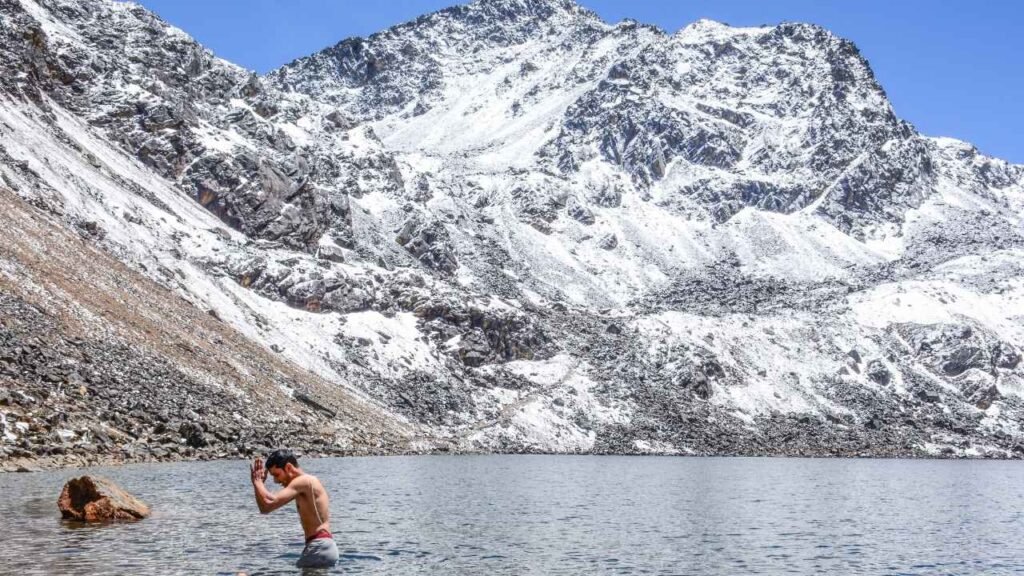
The connection with Shiva and Gosaikunda is especially important in Nepal. Gosaikunda is regarded as a sacred Himalayan lake associated with Shiva, and the annual Janai Purnima pilgrimage brings devotees to the lake for ritual bathing and worship. This represents another dimension of the festival: rather than being confined to the sacred-thread ceremony, Janai Purnima is also connected with pilgrimage and regional religious traditions.
What Happens on Janai Purnima?
Janai Purnima is not a single ceremony performed in exactly the same way by everyone. It is a full-day religious and cultural observance, and the customs vary according to community, family tradition, region, and religious lineage. The most recognizable practices are ritual bathing, worship, renewal of the sacred thread, receiving a protective thread, visiting temples or pilgrimage sites, and sharing a festive meal.
For people who traditionally wear the Janai, the day often begins with ritual purification, followed by prayers and the renewal of the sacred thread. Nepal Tourism Board describes Brahmins gathering at holy riverbanks, taking ritual dips, making offerings to deities, and then changing their sacred threads. Priests also tie yellow sacred threads around devotees’ wrists.
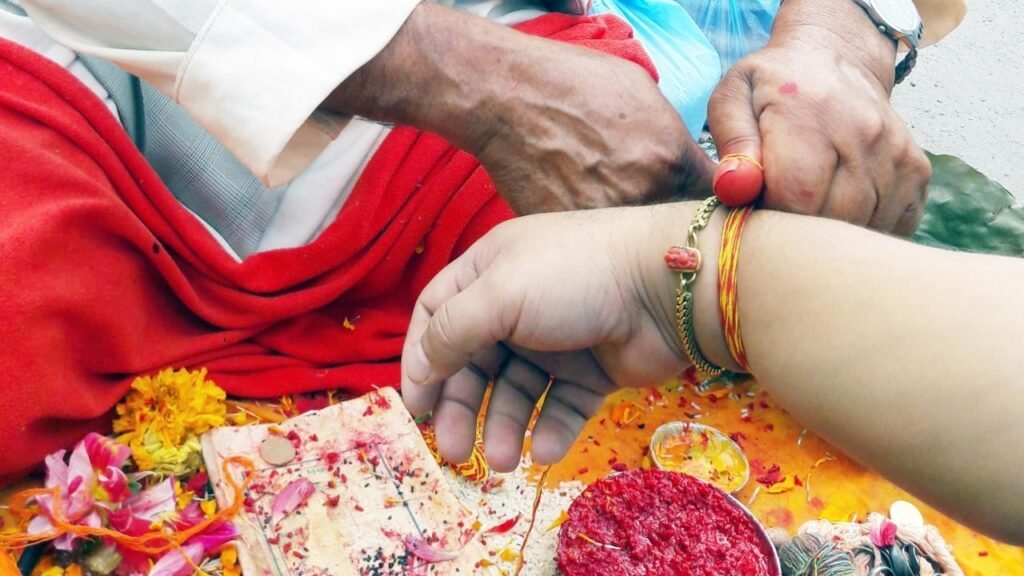
The sequence is not necessarily identical in every household, but the celebration can be understood broadly as follows:
- Ritual Bathing and Purification
Devotees bathe, particularly at rivers, ponds, or other sacred water sources where accessible. The bath has a ritual purpose: preparing oneself for worship and religious observance.
- Prayer and Offerings
People visit temples, shrines, or sacred places to offer flowers, food, water, incense, and other offerings according to their tradition. Shiva temples are particularly associated with Janai Purnima observances in Nepal.
- Renewal of the Janai
Those who traditionally wear the sacred thread undergo the Janai-changing ritual, generally with the involvement of a priest. The old thread is removed and a newly consecrated one is worn.
- Receiving the Protective Thread
Priests bless and tie a sacred thread, commonly called doro or rakshya sutra, around the wrist of devotees. This practice is broader than the Janai-changing ceremony, so people can participate in Janai Purnima without wearing a Janai themselves.
- Family Gathering and Food
Janai Purnima is also a family occasion. People return home, share meals, and prepare traditional foods, most notably Kwati, a soup made from sprouted beans and legumes. Nepal Tourism Board specifically identifies family gatherings and Kwati as important parts of the festival.
- Pilgrimage
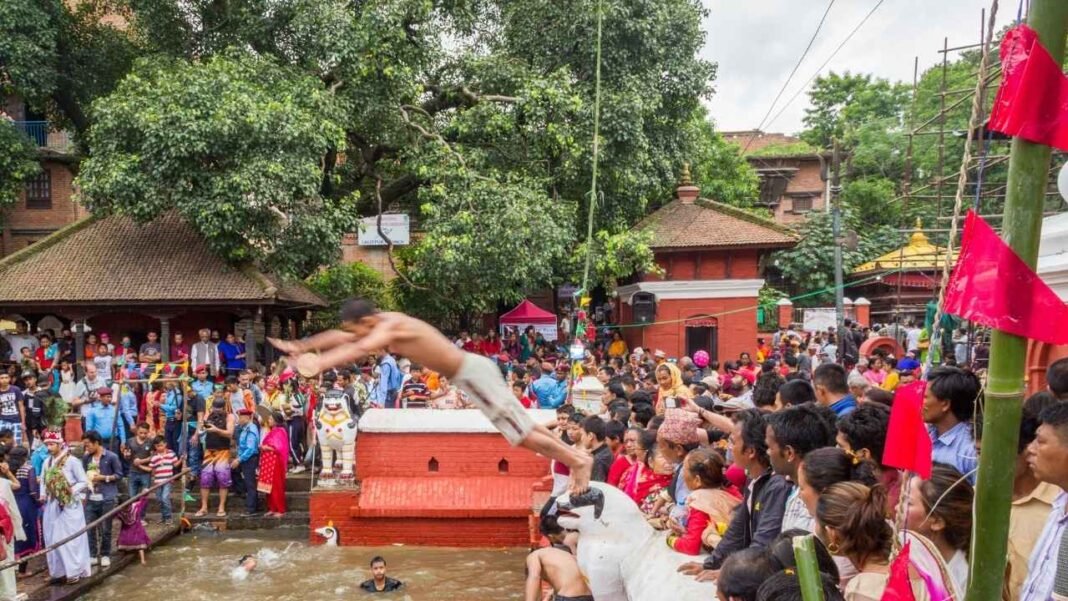
For some devotees, the festival involves traveling to a sacred site rather than simply attending a local temple. Gosaikunda is the most famous example, where pilgrims undertake the difficult journey to the Himalayan lake and traditionally take a holy bath. Other religious centers, including Kumbheshwar in Patan, also attract large gatherings during the festival.
This variation is important. Janai Purnima is a shared festival, but not a uniform ritual. A Brahmin household renewing the Janai, a Newar family celebrating Gunhi Punhi with Kwati, and a pilgrim traveling to Gosaikunda may all be observing the same festival through quite different practices.
Janai Changing Ceremony
The Janai-changing ceremony is one of the defining religious practices of Janai Purnima, but it applies specifically to people who traditionally wear the sacred thread. It should therefore not be presented as a ceremony that every person attending Janai Purnima must perform.
The ritual is traditionally carried out with the assistance of a Hindu priest, who conducts or guides the religious procedures and provides the necessary blessings and mantras. Before changing the thread, the participant undertakes ritual purification, traditionally including bathing. Nepal Tourism Board specifically records Brahmins taking ritual baths at holy riverbanks before changing their sacred threads.
The old Janai is then removed and replaced with a new sacred thread that has been ritually prepared or consecrated. The precise mantras and ritual sequence can vary according to the practitioner’s religious tradition and lineage, so it is better not to claim that every Nepali Hindu follows one identical formula.
The significance lies in the renewal. The Janai is associated with religious discipline and responsibilities acquired through the sacred-thread initiation, or Upanayana/Bratabandha. Replacing it during Shrawan Purnima therefore represents a renewal of ritual purity and commitment to those religious obligations.
It is also useful to distinguish Janai renewal from the wider festival. A person can participate in Janai Purnima by visiting a temple, receiving a protective thread, joining family celebrations, eating Kwati, or undertaking pilgrimage without personally changing a Janai.
Doro: The Sacred Protective Thread
Another important tradition of Janai Purnima is the doro, a sacred thread tied around the wrist after being blessed through religious rituals. This practice is distinct from the brother-sister Raksha Bandhan tradition, even though both involve a thread and share the broader idea of protection.
During Janai Purnima, Hindu priests traditionally tie the doro around the wrist of devotees after performing prayers and religious rites. The thread is regarded as auspicious and is traditionally associated with protection, blessings, and spiritual well-being. The exact color and ritual procedure can vary according to local and religious traditions.
The doro is therefore a religious protective thread, not the same thing as the rakhi exchanged between brothers and sisters during Raksha Bandhan. A person receiving doro does not need to have a brother or sister involved, and the ritual is not centered on a sibling relationship.
Doro vs. Rakhi
The distinction is particularly important because the two traditions are often combined or confused when Janai Purnima is described for international audiences.
| Tradition | Doro on Janai Purnima | Rakhi on Raksha Bandhan |
| Main relationship | Devotee and religious tradition | Brother and sister |
| Who ties it? | Traditionally a priest | Traditionally, a sister ties it on her brother |
| Where is it tied? | Usually around the wrist | Usually around the wrist |
| Main meaning | Religious blessing, auspiciousness, and protection | Sibling affection and the bond of protection |
| Festival context | Janai Purnima | Raksha Bandhan |
| Who participates? | Devotees participating in the religious observance | Traditionally brothers and sisters |
This distinction also helps explain why Janai Purnima and Raksha Bandhan should not be treated as identical festivals. The two occur around the same period and have overlapping ideas of protection, but their rituals and social meanings are different.
In Nepal, Janai Purnima encompasses several traditions, including the renewal of the Janai among those who traditionally wear it, priest-blessed doro, temple worship, pilgrimage, and community-specific celebrations. Raksha Bandhan, by contrast, is most strongly associated with the rakhi ceremony between brothers and sisters and is particularly prominent in the Terai and across the wider South Asian cultural region.
For this reason, it is more accurate to describe doro as one of the protective-thread traditions of Janai Purnima, rather than labeling the doro itself as Raksha Bandhan.
Kwati: The Traditional Food of Janai Purnima
If there is one food that immediately connects Janai Purnima with everyday Nepali culture, it is Kwati. Kwati is a traditional soup made from a mixture of beans and legumes, commonly prepared after they have been soaked and allowed to sprout. Nepal Tourism Board describes it as a nutritious soup made from sprouted beans and identifies it as a special food prepared by Newars of the Kathmandu Valley for Gunhi Punhi, their name for Janai Purnima.
Nepal Tourism Board’s heritage-cuisine material gives a recipe for Quanti/Kwati made from nine varieties of sprouted beans, although the exact combination can vary between households and recipes. The same source notes that sprouting increases the nutritional value of the legumes and that the dish is associated specifically with Janai Purnima.
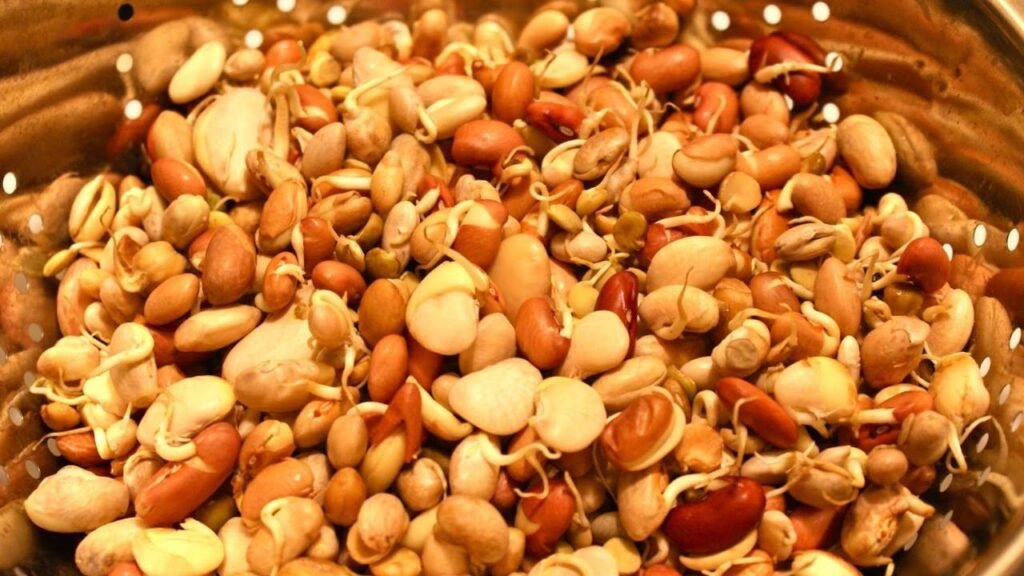
The traditional preparation begins by soaking the beans, allowing them to germinate, and then cooking them into a thick, nourishing soup with spices and other ingredients. Because households use different combinations of legumes, spices, and vegetables, there is no single recipe that represents every version of Kwati.
Its popularity during Janai Purnima also makes practical sense. The combination of different legumes provides protein, carbohydrates, fiber, vitamins, and minerals, making Kwati a substantial food rather than merely a ceremonial dish. The Nepal Tourism Board’s heritage-cuisine publication specifically notes the protein and vitamin content of the sprouted beans.
Common Foods Associated With Janai Purnima
| Food | Role During Janai Purnima |
| Kwati | Traditional festival soup made from mixed sprouted beans and legumes |
| Rice | Common staple served with the festival meal |
| Dal | Common part of a traditional Nepali meal |
| Seasonal vegetables | Often served alongside rice, dal, or other dishes |
| Sweets | May be prepared or offered as part of family and religious celebrations |
The important point is that Kwati is the distinctive Janai Purnima food, while rice, dal, vegetables, and sweets are broader components of Nepali festive and household meals rather than exclusive Janai Purnima dishes. That distinction keeps the food section culturally accurate rather than making ordinary Nepali foods appear unique to the festival.
Janai Purnima Across Nepal
Janai Purnima is celebrated throughout Nepal, but the rituals and atmosphere vary considerably by community and region. In the Kathmandu Valley, devotees visit temples, receive sacred threads (doro) from priests, and perform household prayers, while major temples can become particularly busy. Pashupatinath and other important Hindu shrines are among the places where visitors may encounter the festival, alongside distinctive Newar religious and food traditions in Kathmandu, Lalitpur, and Bhaktapur.
The most prominent pilgrimage associated with Janai Purnima takes place at Gosaikunda, a sacred alpine lake in the Langtang region traditionally associated with Lord Shiva. Thousands of pilgrims make the demanding journey to the lake, where ritual bathing and prayer are central to the observance. For devotees, bathing in the sacred waters during Janai Purnima carries religious significance; for Nepal more broadly, the pilgrimage is also a major cultural event that brings together people from different parts of the country.
The festival is not identical across Nepal. Brahmin and Chhetri communities traditionally place strong emphasis on changing the Janai, while other Hindu communities may focus more on receiving protective threads, temple worship, family rituals, or locally established customs. Newar communities observe the day through their own combination of religious and cultural practices, including distinctive foods and community traditions. In other parts of Nepal, Janai Purnima may overlap with regional forms of Raksha Bandhan and locally specific celebrations.
This diversity is important: Janai Purnima is best understood not as one standardized ceremony, but as a shared festival expressed through Nepal’s many regional and community traditions.